↑ Free AI photo check · For adults 18+

Why Do I Look Bad in Photos?

Almost every disappointing photo fails for a photo-specific reason — camera distance, frozen expression, harsh light, a tight crop — not your face. Here is what the research says, plus a free check that names the reason in your own photo.

No accountNo public ratingOriginal photo deleted after processing

Home/Why Do I Look Bad in Photos?
amipretty.org — photo checkPrivate · 18+

Upload the photo that bothered you. The check reads its light, framing, crop, and expression, then names what specifically made it unflattering.

Choose a Photo

  • Use a photo with one clearly visible adult face.
  • The photo you dislike is the best one to test.
  • Your processed photo is analyzed privately, then deleted.

↑ Mirror vs photo

Why Your Mirror Face Looks Better Than Your Photo Face

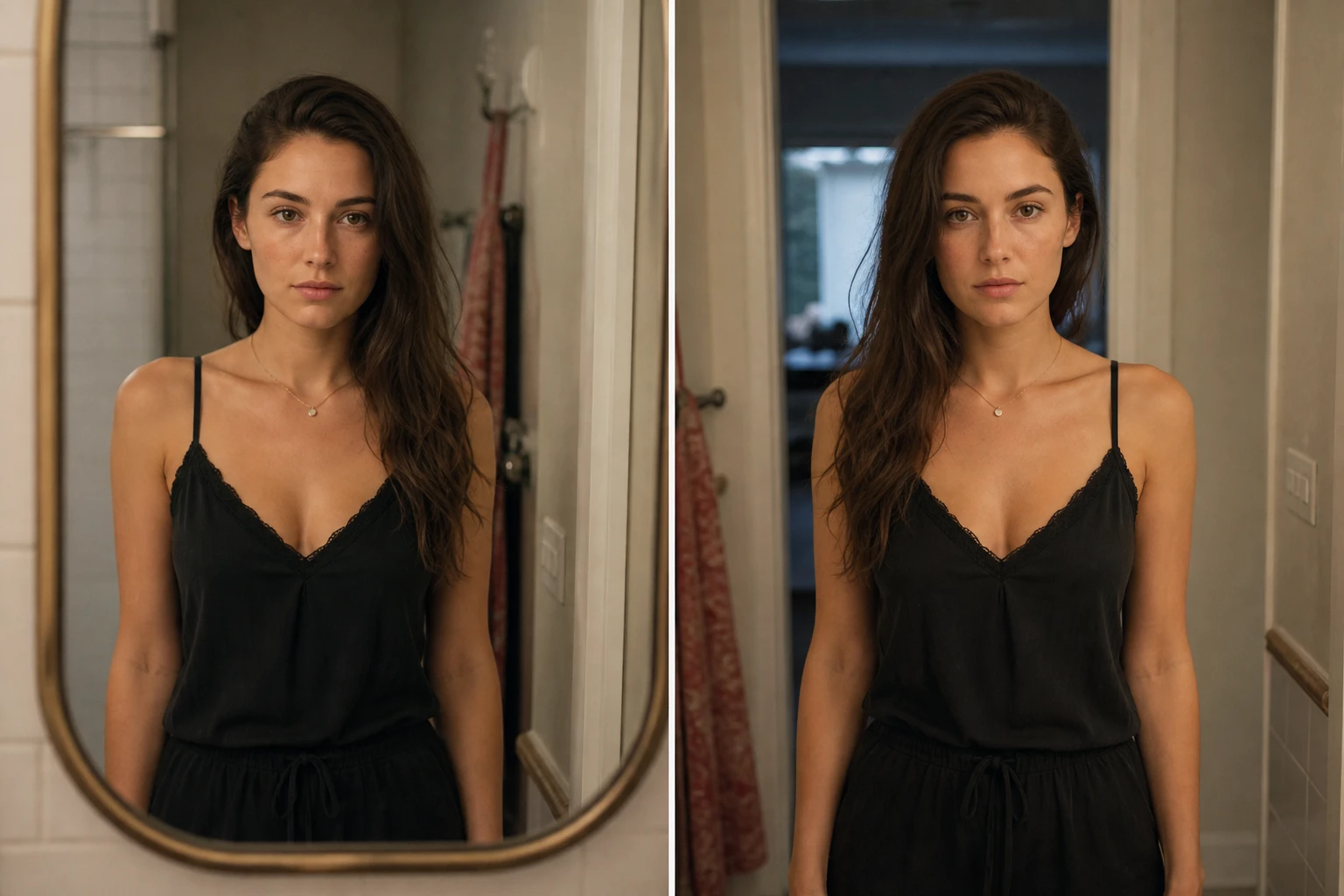
The most common reason photographs startle us is simple: the face you know best is the mirror version, and that is not what anyone else sees.

The same synthetic adult woman reflected in a bathroom mirror beside the same woman photographed directly, her hair falling on opposite shoulders in the two views
The mirror shows the flipped face you know; the photo shows the one everyone else sees.

Why do I look better in the mirror than in photos?

Psychologists call it the mere-exposure effect: people like what they have seen before, purely for its familiarity. Robert Zajonc demonstrated the effect in 1968, and on your own face it operates at full force. The face you see while brushing your teeth is laterally flipped, so that is the orientation your brain has cataloged as "you." A photograph shows the unflipped version — a face with your features in your less-familiar arrangement. To you it reads as subtly off. To everyone else, the photo is the correct one and the mirror is the strange one.
Your mental self-image is a flattering edit

The mismatch goes further. In a 2008 study, Epley and Whitchurch found that people recognize their own face faster and more confidently when the image has been morphed to be slightly more attractive than their actual photo — we hold a subtly enhanced internal portrait of ourselves. A plain photograph, carrying no such enhancement, compares unfavorably against the picture in your head. That gap feels like the camera "doing something wrong." In reality it is the one image in the comparison that is honest.

A photo freezes what a mirror animates

A mirror always shows you in motion: micro-adjustments of posture, blinks, the natural asymmetry of a live expression. Research on the "frozen face effect" (Post, Haberman, and Iwaki, 2012) found that individual still frames taken from video of a face are rated as less flattering than the moving video itself. Every photo you have ever seen of yourself is a frozen frame — one instant, with no motion to carry it — chosen by accident rather than by you.

↑ The camera flattens

Why Do Photos Make You Look Bad? Flattening, Distance, and One Frozen Moment

Beyond familiarity, the camera itself changes how a face reads. Two mechanisms matter most — and both are variables you control.

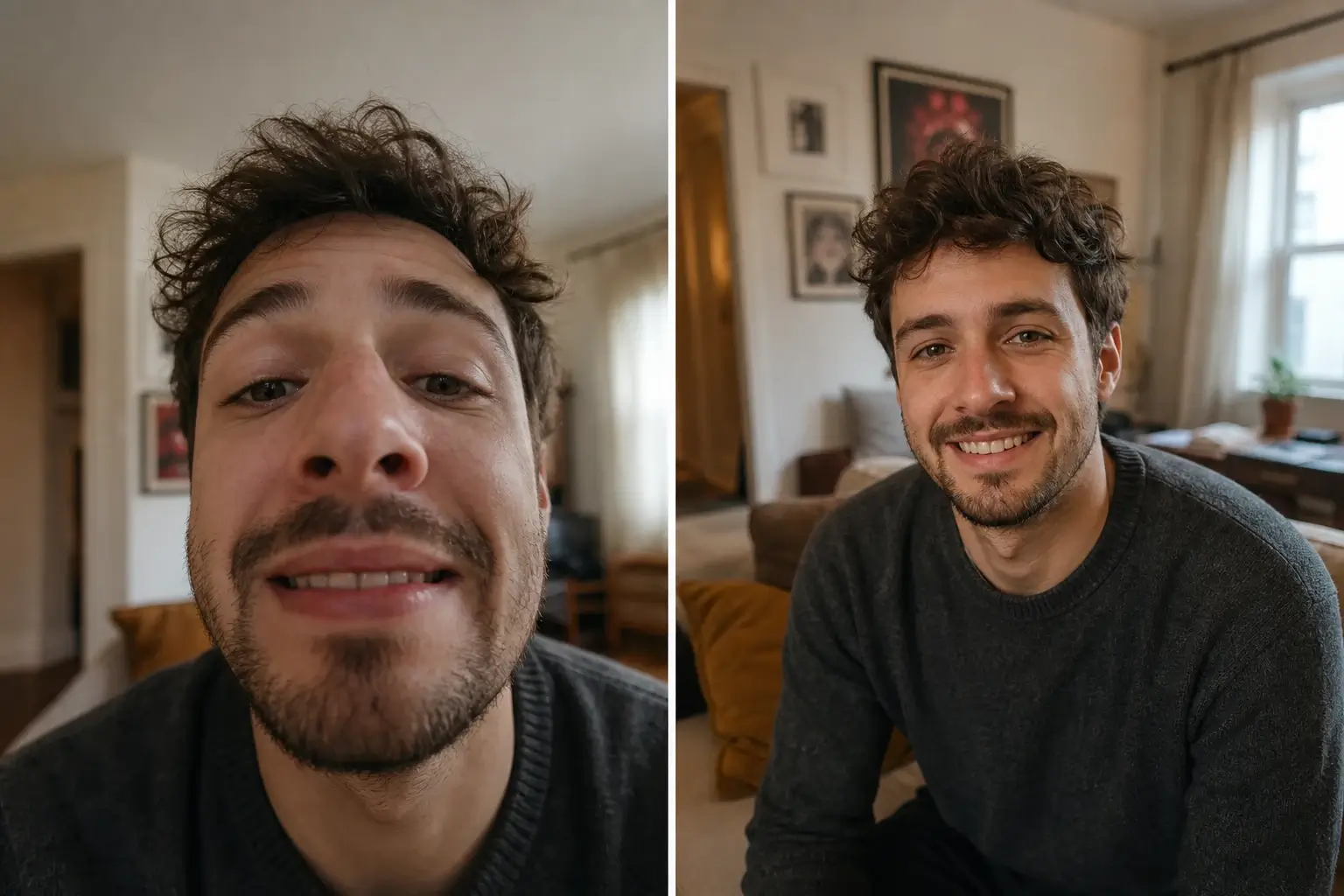
The same synthetic adult man in a close arm's-length selfie with an exaggerated nose beside the same man photographed at conversation distance with natural proportions
Selfie distance exaggerates the center of the face; step back to conversation distance and proportions return.

Close distance exaggerates the middle of your face

Selfies are taken at arm's length or closer — far inside the distance friends see you from. Shot that close, perspective exaggerates whatever is nearest the lens: the nose grows relative to the ears and the head outline, and the overall proportions shift. The effect is driven by camera distance (and focal length along with it), which is why the same face reads noticeably different from across a room than at selfie range. It is geometry, not judgment.

Three dimensions become two

In person, depth cues — shading, parallax, the way light moves across contours as you move — make a face read as a structured object. A photo flattens all of that into one fixed combination of light and angle. Research on within-person face variation (Jenkins, Van Montfort, White, and Burton, 2011) shows different everyday photos of the same person produce strikingly different impressions, and Todorov and Porter (2014) found the same for judged traits: which photo is chosen changes what people infer. A bad-looking photo is often just one unlucky flattening among many possible ones.

One instant, frozen by accident

Live conversation gives people thousands of micro-impressions per minute, most of them neutral or pleasant. A camera keeps exactly one — and in an ordinary burst of frames, several will catch a half-blink, a transition expression, or a tense jaw. It does not choose badly on purpose; it simply does not choose at all.

↑ What actually went wrong

Why Photos Go Bad: Five Predictable, Fixable Reasons

Once familiarity and flattening are accounted for, a specific photo usually disappoints for one or more of five concrete reasons. Each one is a variable of the photo — not a fact about your face — and each is fixable in the next shot.

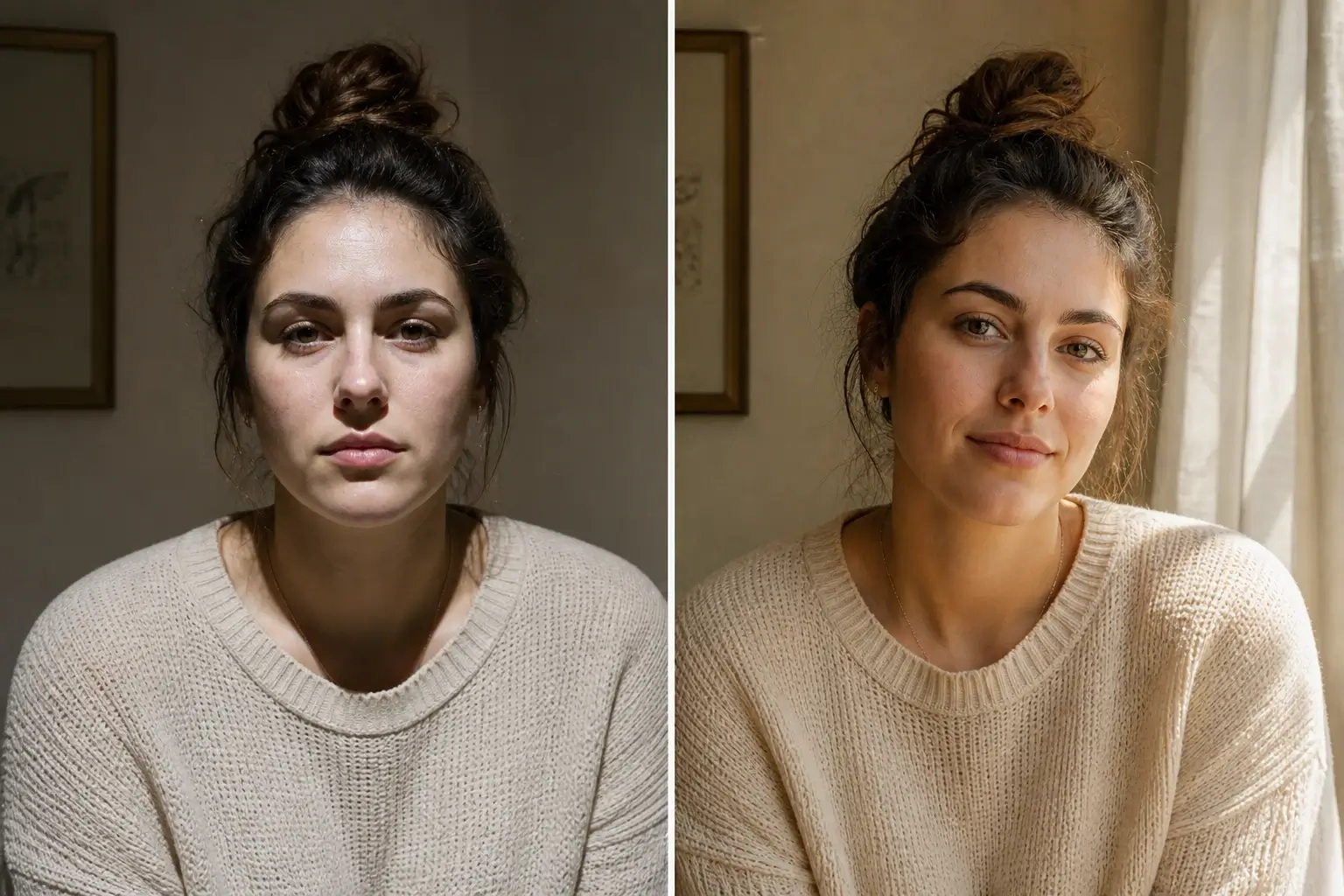
The same synthetic adult woman under harsh overhead ceiling light with hard shadows beside the same woman lit by soft directional window light
Hard overhead light carves shadows; soft window light is the single cheapest upgrade.

1. Hard or misplaced light

Overhead ceiling light carves shadows under the eyes and nose; direct flash flattens the face into a pale rectangle; strong noon sun creates harsh contrast. Soft, directional light — a window, open shade, golden hour — is the single largest upgrade available to any photo.

2. Camera too close, too low, or too high

Close, below-eye-level angles exaggerate the nose and jawline; extreme high angles compress the forehead. Eye level or slightly above, from farther back than feels necessary, keeps proportions closest to real life.

3. A frozen, strained expression

Held smiles read as held. The gap between your animated self and your photo self is mostly expression timing: exhaling, laughing just before the shot, or moving between frames beats posing and holding still.

4. Crop and framing fights the face

Cutting through joints — neck, chin, forehead — creates subconscious tension. Breathing room above the head and below the shoulders lets the face sit comfortably in the frame.

5. A background that competes

Clutter, strong lines, or a background brighter than the face pulls attention away. A step to the left is often the cheapest photo improvement.

The practical takeaway: nearly every "why do I look bad in photos" complaint traces to variables that reset with the next photo. That is why the check above reads the specific photo instead of offering generic advice — the fix depends on which variable actually failed.

↑ FAQ

Questions, Answered Plainly

Why do I look better in the mirror than in photos?

Two effects combine. First, you know your mirror face: it is the flipped version you have seen for years, so mere-exposure makes it feel more right. Second, a mirror shows a moving, animated face, while a photo freezes one instant — and frozen frames of the same person are consistently rated less flattering than the moving version. Others share neither disadvantage; they only ever see the true, unflipped, moving you.

Is it true the camera adds weight or distorts your face?

Close camera distance does. Selfie-distance photos are taken from well inside a normal conversation distance, and shooting a three-dimensional face from that close exaggerates the center of the face — the nose — relative to the ears and head outline. The effect comes from proximity and angle, not the camera lying: step back and proportions return to what people see in person.

Do I actually look like the person in my photos?

You look like every photo of yourself a little differently. Research on within-person face variation shows that different photos of the same person produce meaningfully different impressions, and observers' judgments of attractiveness shift from image to image. A single bad photo is real evidence about that photo, not about your face.

Why do I look worse in photos than my friends say I look in person?

In person, people experience you in motion, in conversation, in changing light — a composite that is almost always kinder than one frozen frame. They also see you unflipped, while your sense of your own face is mirror-flipped. A photo that matches the frozen, unflipped, flattened version feels wrong to you in a way it never does to people who know you.

Can a photo really tell me why I look bad in it?

Often, yes. Most disappointing photos fail for a small set of photo-specific reasons: harsh or flat lighting, a too-close or too-low camera angle, a crop that cuts the head or chest awkwardly, a strained frozen expression, or background clutter competing with the face. Those are exactly the dimensions a structured photo check reads — which is why the check above can name what dragged your photo down.

How do I stop looking bad in photos?

Fix the photo variables, not your face. Face a window or soft light, raise the camera to eye level or slightly above, step back farther than feels natural, relax your expression by moving slightly before the shot, and give the crop headroom. Then verify with a check of the new photo instead of guessing.

Do I need an account, and what happens to my photo?

No account or email is needed for the free check. The processed photo is kept privately only while processing, then deleted, and is never used to train AI models.

↑ Sources & limitations

What the Research Above Actually Says

These papers support the mechanisms on this page. None measures your worth; none supports ranking people.

Am I Pretty? evaluates photo presentation — never personal worth, identity, or a universal standard.

Ready to See What Went Wrong in Your Photo?

Run the free check above on the exact photo that bothered you, then get three AI-corrected directions for it.

Check My Photo — Free